
John Deere Tire Pressure Chart PDF: A Comprehensive Guide
Navigating John Deere tractor tire pressures is crucial for optimal performance; this guide provides a detailed overview, including PDF chart access and essential insights.
Understanding the Importance of Correct Tire Pressure
Maintaining accurate tire pressure in your John Deere tractor is paramount for maximizing its operational efficiency and longevity. Incorrect inflation directly impacts fuel consumption, potentially leading to increased costs and reduced productivity. Proper pressure ensures optimal handling and maneuverability, especially crucial during demanding agricultural tasks.
Furthermore, correct inflation significantly extends tire lifespan, preventing premature wear and tear and reducing the need for frequent replacements. Ignoring recommended pressures can compromise safety and negatively affect the tractor’s overall performance. Consulting the John Deere tire pressure chart PDF is the first step towards achieving these benefits.
Impact on Fuel Efficiency
Under-inflated tires create significantly more rolling resistance, forcing your John Deere tractor’s engine to work harder to maintain speed and power. This increased effort directly translates to higher fuel consumption, impacting operational costs. Conversely, over-inflated tires reduce the contact patch, diminishing traction and potentially leading to slippage, also reducing efficiency.
The John Deere tire pressure chart PDF provides precise inflation recommendations to minimize rolling resistance and optimize fuel economy. Adhering to these guidelines ensures your tractor operates at peak efficiency, saving you money and reducing your environmental footprint.
Influence on Tractor Handling
Correct tire pressure is paramount for safe and predictable tractor handling. Under-inflated tires cause instability, particularly during turns, increasing the risk of rollovers, especially on uneven terrain. Over-inflation reduces the tire’s ability to absorb shocks, resulting in a harsher ride and diminished operator comfort.
The John Deere tire pressure chart PDF details the optimal inflation levels for various applications, ensuring responsive steering, stable operation, and enhanced control. Following these recommendations maximizes handling performance and contributes to a safer working environment.
Extending Tire Lifespan
Maintaining proper tire pressure, as outlined in the John Deere tire pressure chart PDF, significantly extends tire lifespan. Under-inflation leads to excessive sidewall flexing, generating heat and accelerating tire wear. This also increases the risk of impact damage and premature failure.
Conversely, over-inflation makes tires more susceptible to damage from rocks and other debris. Adhering to the recommended pressures minimizes these issues, promoting even tread wear and maximizing the return on your tire investment, ultimately reducing long-term operating costs.
Locating the Official John Deere Tire Pressure Charts
Accessing official John Deere tire pressure charts is readily available through operator’s manuals and the official John Deere website for accurate data.
John Deere Operator’s Manuals
Your John Deere tractor’s operator’s manual is the primary source for precise tire pressure specifications. These manuals, often available for free download on the official John Deere website, contain dedicated sections detailing the recommended pressures for various tire sizes and load conditions. Locate your specific model number to ensure you’re referencing the correct information. The manual will outline front and rear tire pressures, considering different operating environments. Furthermore, John Deere provides options to purchase physical copies of these manuals if a digital version isn’t preferred. Regularly consulting your operator’s manual guarantees optimal tractor performance and safety, preventing premature tire wear and maximizing fuel efficiency. Always prioritize the manual’s recommendations over generalized charts.
Online Resources: Official John Deere Website
The official John Deere website serves as a central hub for accessing tire pressure charts and related documentation. You can find operator’s manuals, parts catalogs, and technical publications, including those containing crucial tire inflation data. The website offers free downloads of operator manuals and installation instructions. Navigating to the support or resources section, then searching by your tractor model number, will yield relevant results. Direct links to specific charts, like OMRE268160 for 5103, 5203, 5303, and 5403 tractors, are often available. This ensures you obtain the most accurate and up-to-date information directly from the manufacturer.
Specific Model Charts: OMRE268160 (5103, 5203, 5303, 5403 Tractors)
OMRE268160 is a key document for operators of John Deere 5103, 5203, 5303, and 5403 tractors. This block file, SA61034_0000071_19_26NOV07.htm, is directly accessible on the official John Deere website. It details specific tire pressure recommendations tailored to these models, considering various load conditions and tire sizes. Accessing this chart ensures correct inflation for optimal performance and longevity. It’s a vital resource for maintaining fuel efficiency, handling, and preventing premature tire wear. Downloading and referencing OMRE268160 is highly recommended for owners of these tractor series.

Decoding John Deere Tire Pressure Charts
Understanding the terminology, front versus rear pressures, and load index within John Deere charts is essential for accurate tire inflation and tractor operation.
Understanding Chart Terminology
John Deere tire pressure charts utilize specific terms crucial for correct inflation. “PSI” denotes pounds per square inch, the standard unit for tire pressure measurement. Charts often differentiate between radial and bias-ply tires, each requiring distinct pressures. “Load Index” indicates the maximum weight a tire can carry at a specified pressure. Tire size, expressed as a series of numbers and letters (e.g., 23×10.5-12), is vital for identifying the correct pressure range. Understanding these terms ensures accurate inflation, maximizing efficiency and extending tire life. Ignoring these details can lead to improper handling and reduced tractor performance. Always refer to your specific model’s chart for precise specifications.
Front Tire vs. Rear Tire Pressure
John Deere tractors typically require differing tire pressures for the front and rear axles. Front tires generally operate at lower pressures, enhancing steering responsiveness and ride comfort. Rear tires, bearing the majority of the tractor’s weight and workload, necessitate higher pressures for optimal load-carrying capacity and reduced slippage. Charts clearly delineate these distinctions, often providing separate PSI recommendations for each set of tires. Maintaining this pressure differential is critical for balanced handling and efficient operation. Incorrect pressure can compromise stability and accelerate tire wear, impacting overall performance.
Load Index and Tire Size Considerations
John Deere tire pressure charts are intrinsically linked to both the tire’s load index and its size. The load index, a numerical code on the tire sidewall, indicates the maximum weight a tire can carry at a specified pressure. Larger tires, or those with a higher load index, often require different inflation levels than smaller ones. Charts account for these variables, providing tailored PSI recommendations based on tire dimensions and the anticipated load. Ignoring these factors can lead to under-inflation, causing instability, or over-inflation, reducing traction and ride quality.

Common John Deere Tractor Tire Pressures (Examples)
Specific John Deere models, like the E140, have recommended tire pressures; understanding these examples is vital for maintaining optimal tractor performance and safety.
John Deere E140 Tire Pressure
Maintaining the correct tire pressure on your John Deere E140 lawn tractor is essential for a comfortable ride, efficient operation, and prolonged tire life. According to readily available information, the standard tire pressure for a John Deere E140 is 14 psi for the front tires and 10 psi for the rear tires.
However, it’s always best to consult your specific owner’s manual or an official John Deere tire pressure chart, as variations can occur based on tire size and type. Regularly checking and adjusting tire pressure ensures optimal handling and prevents premature wear, contributing to a safer and more enjoyable mowing experience.
Front Tire Pressure (E140)
For the John Deere E140 lawn tractor, maintaining the correct front tire pressure is vital for steering responsiveness and overall handling. The recommended front tire pressure is consistently reported as 14 psi. This pressure ensures adequate support for the machine’s weight distribution, allowing for smooth turning and maneuverability.
Regularly checking the front tires – ideally before each use – and inflating them to 14 psi will contribute to a more comfortable and controlled mowing experience. Always use a reliable tire pressure gauge for accurate readings and avoid over or under-inflation.
Rear Tire Pressure (E140)
Maintaining proper rear tire pressure on your John Deere E140 is essential for a level cut and efficient operation. The standard recommendation for the rear tires is 10 psi. This lower pressure, compared to the front, helps provide better traction and a smoother ride, particularly on uneven terrain.
Consistent monitoring and inflation to 10 psi will optimize the E140’s performance, reducing scalping and improving the quality of your lawn. Utilize a dependable tire gauge and avoid exceeding the recommended pressure to prevent damage or compromised handling.
Typical Tire Pressures for Larger Agricultural Tractors
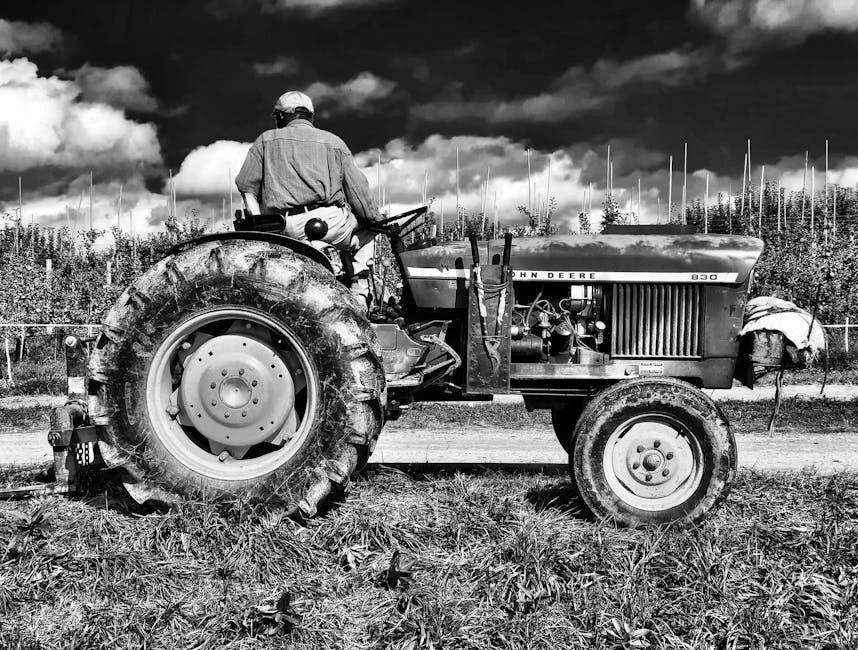
Larger John Deere agricultural tractors necessitate significantly higher tire pressures than compact models like the E140, varying greatly based on tire size, load, and field conditions. Pressures commonly range from 20 to 40 psi, but can exceed this for heavy implements or road transport.
Consulting the specific model’s operator’s manual or the official John Deere charts (like OMRE268160 for 5103/5203/5303/5403 series) is paramount. Accurate inflation maximizes traction, minimizes soil compaction, and extends tire lifespan in demanding agricultural applications.
Factors Affecting Optimal Tire Pressure
Tire type (radial or bias-ply), operating environment (field vs. road), and load weight all influence the ideal John Deere tractor tire pressure settings.
Type of Tire (Radial vs. Bias-Ply)
Understanding the difference between radial and bias-ply tires is fundamental to maintaining correct John Deere tractor tire pressure. Radial tires, characterized by their cord arrangement running perpendicular to the bead, generally offer improved fuel efficiency and a smoother ride. They typically require lower inflation pressures compared to bias-ply tires.
Bias-ply tires, with cords running diagonally, are more common on older tractors and are known for their robust sidewalls and load-carrying capacity. However, they generate more heat and require higher pressures. Always consult your John Deere operator’s manual or official tire pressure chart to determine the appropriate PSI based on your specific tire construction.
Operating Conditions (Field vs. Road)
John Deere tractor tire pressure adjustments are heavily influenced by operating conditions. For field work, particularly in soft or uneven terrain, reducing tire pressure increases the footprint area, enhancing traction and minimizing soil compaction. Lower pressures allow the tire to conform to the ground, improving stability.
Conversely, when transitioning to road travel, increasing tire pressure is essential. Higher inflation reduces rolling resistance, improving fuel efficiency and handling. It also minimizes tire wear on hard surfaces. Regularly adjust pressures based on the predominant operating environment to maximize performance and tire longevity, referencing your John Deere chart.
Load Weight and Distribution
Accurate tire pressure is directly linked to the weight your John Deere tractor carries. Heavier loads necessitate higher inflation pressures to maintain tire structure and prevent damage. Uneven weight distribution – common with implements or full hoppers – requires careful consideration.
Consult your John Deere tire pressure chart, factoring in the total weight and how it’s distributed across the axles. Improperly inflated tires under heavy or uneven loads can lead to instability, increased tire wear, and potential safety hazards. Regularly assess load weights and adjust pressures accordingly for optimal performance.
Tools for Accurate Tire Pressure Measurement
Reliable gauges – both digital and traditional – are essential for precise inflation, ensuring your John Deere tractor operates safely and efficiently per chart guidelines.
Digital Tire Pressure Gauges
Digital tire pressure gauges offer a precise and easy-to-read display, eliminating guesswork when inflating your John Deere tractor tires according to the official charts. These gauges typically feature backlit screens for visibility in low-light conditions and can store previous readings for comparison. Many models include automatic shut-off features to conserve battery life. Accuracy is paramount; look for gauges with a stated accuracy of ±0.5 PSI or better. Digital gauges are particularly useful for consistently achieving the recommended pressures, maximizing fuel efficiency, and extending tire lifespan, as detailed in John Deere’s documentation. They represent a worthwhile investment for serious tractor owners.
Traditional Tire Pressure Gauges
While digital gauges offer convenience, traditional, analog tire pressure gauges remain a reliable and cost-effective option for checking John Deere tractor tire inflation. These gauges utilize a mechanical system with a calibrated spring and a visual scale. Accuracy depends on proper usage and regular calibration. It’s crucial to hold the gauge perpendicular to the valve stem for an accurate reading. Though requiring a bit more interpretation than digital displays, traditional gauges are durable and don’t rely on batteries. Referencing the John Deere tire pressure chart alongside a well-maintained analog gauge ensures correct inflation for optimal tractor performance.
Troubleshooting Tire Pressure Issues
Addressing pressure loss involves identifying under or over-inflation, checking for leaks, and ensuring proper valve stem sealing for safe, efficient operation.
Identifying Under-Inflation
Recognizing under-inflation in John Deere tractor tires is vital for preventing damage and maintaining performance. Visually inspect tires; noticeably bulging sidewalls or a flattened appearance indicate low pressure. A tractor may exhibit sluggish steering and reduced traction.
Furthermore, under-inflated tires generate excessive heat during operation, accelerating wear and potentially leading to tire failure; Regularly check pressure with a gauge, comparing readings to the official John Deere tire pressure chart for your specific model. Consistent monitoring ensures optimal field performance and extends tire lifespan, ultimately saving on replacement costs.
Recognizing Over-Inflation
Detecting over-inflation in John Deere tractor tires is just as crucial as identifying under-inflation. Tires that are overinflated will appear overly rounded, with minimal sidewall flex. You might experience a harsher ride and reduced traction, particularly on uneven terrain.
Over-inflation concentrates wear in the center of the tire tread, shortening its lifespan. It also increases the risk of damage from impacts, like rocks or debris. Always consult the John Deere tire pressure chart for your model and use a reliable gauge for accurate readings to avoid these issues and maintain optimal performance.
Addressing Tire Leaks
Identifying and promptly addressing tire leaks is vital for maintaining correct John Deere tractor tire pressure. Common leak sources include punctures from debris, valve stem issues, or rim corrosion. Regularly inspect tires for embedded objects and check valve stems for cracks or damage.
For slow leaks, soapy water applied to the tire and valve stem can reveal bubbles indicating the leak’s location. Larger punctures may require patching or tire replacement. Ignoring leaks leads to inconsistent pressure, impacting fuel efficiency and handling; consult your John Deere operator’s manual for guidance.
PDF Availability and Download Locations
Official John Deere provides tire pressure charts as downloadable PDFs via their website and operator’s manuals, ensuring easy access to crucial information.
Direct Download Links from John Deere
John Deere’s official website serves as the primary source for authentic tire pressure charts in PDF format. Users can directly access and download these resources by navigating to the support section and searching for their specific tractor model. For instance, OMRE268160, pertaining to 5103, 5203, 5303, and 5403 tractors, is readily available.
The website also offers a comprehensive library of operator’s manuals, parts catalogs, and technical documentation, all accessible through a user-friendly interface. This centralized platform ensures that owners and operators have convenient access to the latest information, promoting safe and efficient tractor operation. Direct links streamline the process, eliminating the need for extensive searching.
Third-Party Resources for PDF Charts
While John Deere’s official website is preferred, various third-party resources offer access to John Deere tire pressure charts in PDF format. Online forums, such as Reddit’s r/HomeImprovement, often host discussions and shared links to these charts, providing a community-driven approach to information gathering. However, verifying the accuracy and model compatibility of charts from unofficial sources is crucial.
These resources can be helpful when direct access to the John Deere website is limited or when seeking supplemental information. Always cross-reference information with official documentation whenever possible to ensure correct tire inflation for optimal tractor performance and safety.
Safety Precautions When Adjusting Tire Pressure
Prioritize safety by using appropriate equipment and inspecting tires for damage before inflation; proper tire condition ensures safe and effective adjustments.
Using Proper Safety Equipment
When adjusting John Deere tractor tire pressure, prioritizing safety is paramount. Always wear safety glasses to protect your eyes from potential debris. Gloves are also recommended to shield your hands. Utilize a reliable tire pressure gauge – digital gauges offer precision, while traditional gauges are a viable alternative. Ensure the air compressor is in good working order with a functioning pressure regulator.
Furthermore, position the tractor on a level surface and engage the parking brake securely. Keep bystanders at a safe distance during inflation. Never exceed the maximum pressure indicated on the tire sidewall, and regularly inspect the valve stem for leaks or damage. Proper equipment minimizes risks and ensures accurate inflation.
Checking Tire Condition Before Inflation
Before inflating John Deere tractor tires, a thorough inspection is essential for safety and longevity. Carefully examine the tire sidewalls for any signs of cracks, bulges, or cuts. Look for embedded objects like nails or screws, which could cause leaks or sudden deflation. Inspect the valve stems for damage or deterioration; replace if necessary.
Additionally, check the tire tread for uneven wear, indicating potential alignment issues. Ensure the rims are free from corrosion or damage. Addressing these issues before inflation prevents potential hazards and maximizes tire performance. Ignoring these checks could lead to tire failure during operation.